Skip to content / 本文へ移動

HASHFLOPS Card Game — Rulebook

HASHFLOPS CARD GAME
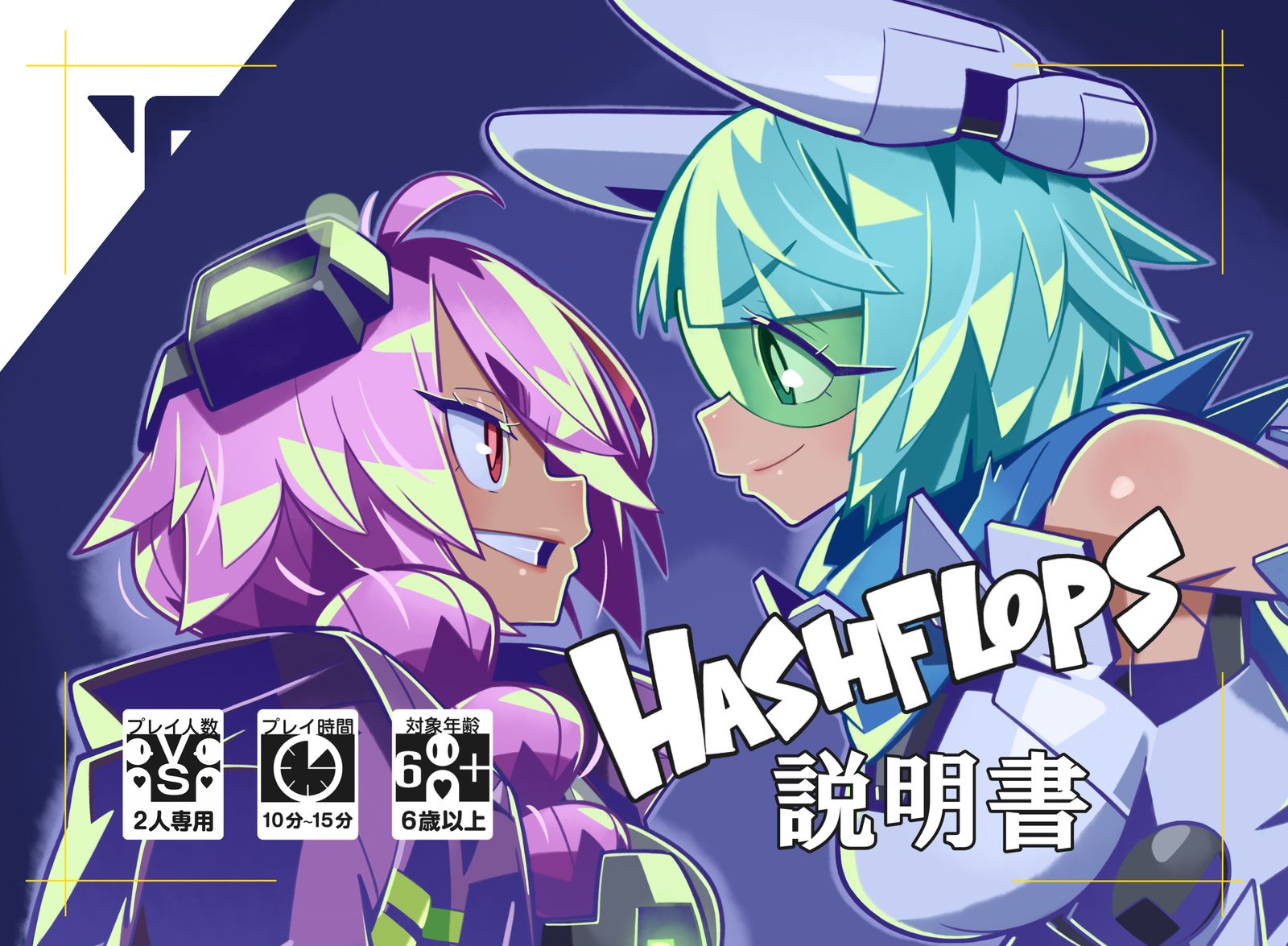
Rulebook cover art

Every turn is a climax.

2 players only10–15 minutes6 and up

Story

Long ago, humanity was destroyed by its own machines — the Gardeners, robots that broke loose from the tasks they were built for.

With humanity gone, the Gardeners turned to healing the ruined land with their own hands, until the planet ran green and blue once more. Their work finished, they lay down deep in the forests and slept, waiting for the day the world's balance might be broken again.

Ages passed. Then, from far across the void, something was detected sleeping in the Earth: an unknown supermetal called Noimanium. The metal is said to hold a strange energy, a power beyond human understanding — enough to give rise to technologies no one has ever dreamed of.

Drawn by Noimanium, the Norma — alien treasure-hunters from across the universe, no two of them alike — converge on Earth. But the prize they seek lies deep inside the forest the Gardeners guard. Waiting there are the Gardeners, roused at last from their long sleep, and rival Norma with their eyes on the very same treasure.

You are the leader of an expedition team. Gather your crew and hunt down the treasure sleeping in the Earth.

The battle for the ultimate treasure begins!
Overview

HASHFLOPS is a head-to-head card game for two players in which both sides reveal a card at the same time to settle each clash.

You fight using the Element (Fire, Wind, Earth, Water) and MP of your Character Cards, and swing the situation your way with Event Cards and Support Cards. The loser loses life equal to the base MP of their own Battle Card.

You win by reducing your opponent's life to 0. If the Character Card deck and both players' hands all run out first, the player with more life remaining wins.

The Card Set (what you buy)

Character Card (front)
Character Card (back)
Event Card (front)
Event Card (back)
  • 32 Character Cards (8 each of Fire, Wind, Earth, and Water; base MP across the set is 1–4 lit hearts)
  • 16 Event Cards (10 Standard, 4 Element Advantage, 1 Low-MP Victory, 1 Hand-Pick)

The physical product is this 48-card set only. The cards are printed in Japanese.

The 48-card set at a glance

32 Character Cards and 16 Event Cards. Every segment is labeled as well as color-coded.

Character Cards32
Fire8Wind8Earth8Water8
Event Cards16
Standard10Element Advantage4Low-MP Victory1Hand-Pick1

Reading the Japanese Cards

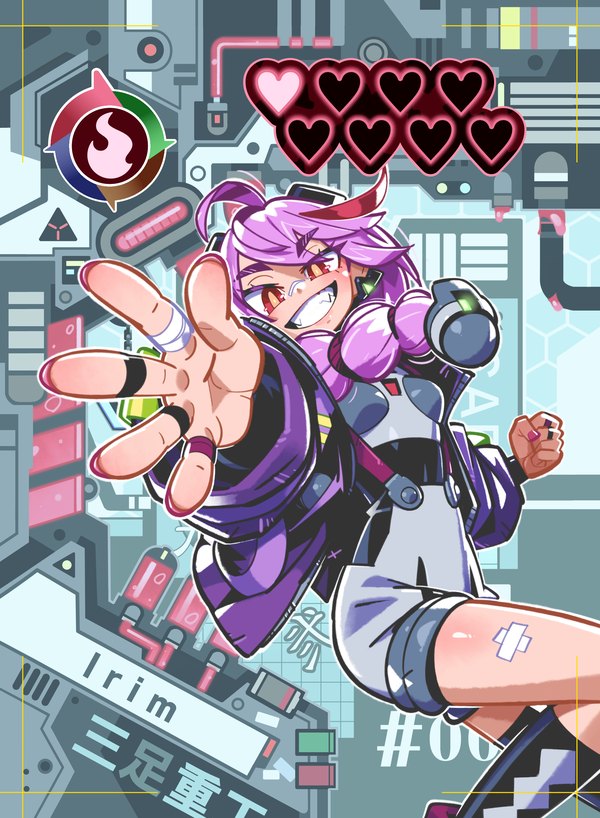
  • Read the Element from the pictogram in the center of the round mark at the upper left. The physical cards do not print Element kanji.
  • Base MP is the number of lit/filled hearts among the eight hearts at the upper right. Do not count the dark hearts. Base MP ranges from 1 to 4.
PictogramElementGuide color
Flame pictogramFireRed
Spiral-gust pictogramWindGreen
Sprout-from-ground pictogramEarthOrange
Water-drop-and-bubbles pictogramWaterBlue

What else you need (all free)

Setup

  1. Play rock-paper-scissors. The winner becomes the first player. The first player stays the same for the whole game.

  2. Shuffle the 32 Character Cards well and deal 5 cards to each player. Hold them as your hand, kept out of your opponent's sight. Each turn you will play one card from this hand; the card you play is your Battle Card for that turn.

    Next, deal 3 more cards to each player and place them face up in front of you. These are your Support Cards. You never gain additional Support Cards during the game.

    Make the remaining 16 cards one Character Card deck and place it face down in the playmat's Character Card deck space on the left. Always draw in first-player, then second-player order.

  3. Shuffle the 16 Event Cards well and place them face down on the marked space as the Event deck.

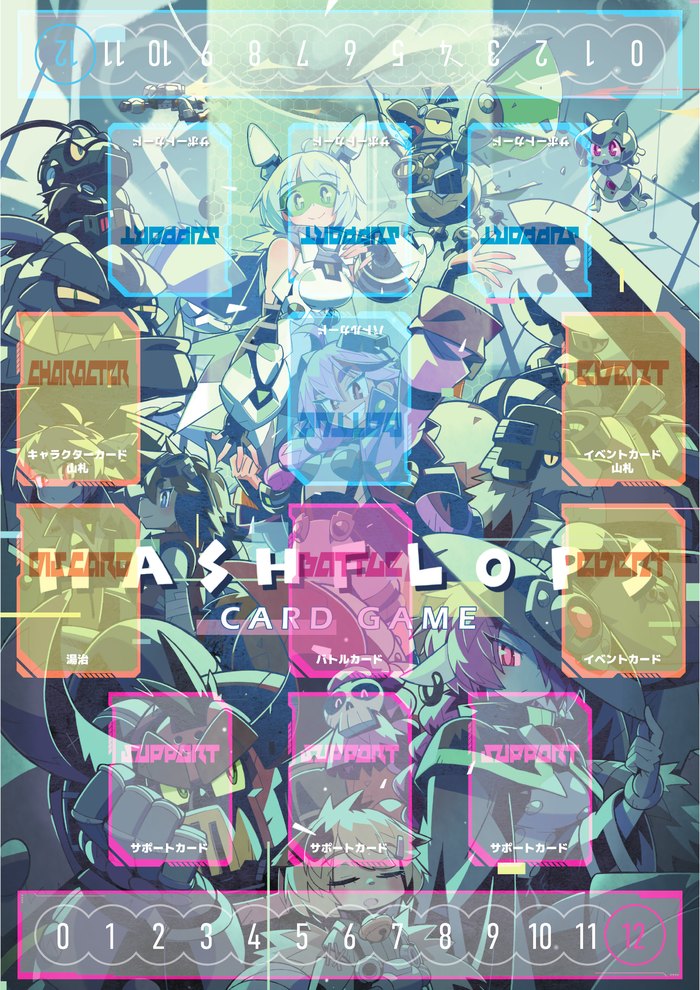
  4. Each player picks a color (red or blue) and places one Life Token of their color on the "12" space of the life track on the playmat (the other three tokens are spares).

The playmat — where everything goes

How the 32 Character Cards are dealt

5 + 3 + 16 + 3 + 5 = 32. Make the 16-card Event deck separately.

Character Cards32
  1. Player 1 hand5Keep hidden
  2. Player 1 Supports3Place face up
  3. Draw deck16One deck, face down
  4. Player 2 Supports3Place face up
  5. Player 2 hand5Keep hidden

Events: shuffle all 16 into one deck

Life: place one red and one blue token on “12”

Turn Flow (Phases 1–7)

One turn, seven phases

Follow the numbered sequence. If no victory condition is met, begin the next turn.

  1. 1EventReveal one
  2. 2SelectionPlay face down
  3. 3RevealTurn up together
  4. 4SupportFirst → second
  5. 5BattleSpecial checks first
  6. 6ResultLife and Tōji
  7. 7DrawFirst → second
  1. Event Phase — The first player flips the top card of the Event deck and reveals it as this turn's Event. Place it face up on top of earlier Event Cards in the playmat's Event Card space. Apply its effect in the relevant phase described below. Event effects last for this turn only.

  2. Selection Phase — Each player chooses one card from their hand and plays it face down.

    Note: When a Hand-Pick Event is in play: each player fans out their hand face down and offers it to their opponent; the opponent picks one card, and that card becomes the offering player's Battle Card (the picker never sees the faces). The chosen card is placed face down in play as usual — you do not also pick a card for yourself this turn.

  3. Reveal Phase — Both players turn their face-down cards face up at the same time.

  4. Support PhaseStarting with the first player, each player may add 0 to 2 Support Cards from in front of them, provided each one has the same Element as the card they revealed in Phase 3. The first player confirms their additions face up; the second player then chooses after seeing them.

    Skip the Support Phase when an Element Advantage Event is in play and exactly one player revealed the crowned Element, or when a Low-MP Victory Event is in play.

  5. Battle Phase — Check special-Event win conditions first. Only when neither decides the battle do you calculate and compare final MP. (See "Battle" below for the full procedure.)

  6. Result Phase — The player who lost moves their own Life Token down the life track by the base MP of their own Battle Card (Support Cards do not count). Life never goes below 0. If the battle was a draw, neither player loses any life.

    Then (on drawn turns as well), stack both Battle Cards and only the Support Cards added this turn face up in the playmat's single Tōji zone at the lower left (Tōji, "hot-spring retreat" — the out-of-play rest area). Event Cards never go to Tōji; leave them stacked face up as discards in the Event Card space.

  7. Draw Phase — If both players still have at least 1 life after Phase 6, each player draws 1 card from the single Character Card deck, in first-player, then second-player order, and adds it to their hand.

    If the Character Card deck is empty, skip the draw. Immediately after drawing, or after skipping because the deck is empty, check whether the Character Card deck and both players' hands are all empty.

If neither player has met a victory condition, begin the next turn (Phases 1–7).

Battle

Resolve each battle from top to bottom. When a special Event decides the battle, do not continue to the later steps.

Battle resolution starts with the Event

Check from top to bottom and stop as soon as a special Event decides the battle.

  1. 1

    Does the Event decide the battle by itself?

    Low-MP Victory

    Lower base MP wins. A base-MP tie uses Element advantage.

    No Supports

    Element Advantage

    If exactly one card matches the crown, that player wins.

    No Supports

    Otherwise

    This includes both or neither matching the crown. Continue to final MP.

    Continue
  2. 2

    Calculate and compare final MP

    base MPSupport MPStandard Event effectfinal MP (max 8)
  3. 3

    Higher wins. A tie goes to Element advantage

  1. Check special Events first — If an Event decides the battle, finish the check here.

    Low-MP Victory Event — The player with the lower base MP wins. If base MP is tied, decide by Element advantage (Fire vs Earth, Wind vs Water, and same-Element pairings are a draw). (Support Cards may not be used.)

    Element Advantage Event — If exactly one player revealed the crowned Element, that player wins. (Support Cards may not be used.) If both players revealed the crowned Element, or neither did, continue to steps 2–3. (Support Cards may be used.)

  2. Calculate final MP — If step 1 did not decide the battle, each player works out their own final MP.

    Final MP (maximum 8) = base MP + Support MP + Standard Event effect

    If the total would exceed 8, treat it as 8. Do not calculate final MP during a Low-MP Victory Event.

  3. Determine the winner — The player with the higher final MP wins.

    If both players have the same value, resolve it by Element advantage: Fire > Wind > Earth > Water > Fire

    Only pairings that sit next to each other in the arrows have an advantage relationship. Pairings with no advantage relationship (Fire vs Earth, Wind vs Water), and two cards of the same Element, are a draw.

Element advantage has four directed relationships

The Element on the left beats the one on the right. Unconnected pairings have no advantage.

  • Fire beats Wind
  • Wind beats Earth
  • Earth beats Water
  • Water beats Fire
No advantage: Fire vs Earth / Wind vs Water / two cards of the same ElementA tied value is a draw

Worked example on an eight-step MP bar

A total above 8 still produces a final MP of 8.

Fire2 + 3 + 2 + 3 = 10 → capped at 8
Wind3 + 2 + 2 = 7

Fire wins. The losing Wind player loses 3 life—their Battle Card’s base MP, not its final MP of 7.

Which Number Do I Use, and When?

To determineUse
An Element Advantage Event where exactly one Battle Card matches the crownThe player whose card matches the crowned Element wins
A Low-MP Victory EventBase MP (lower wins; if tied, Element advantage)
The winnerFinal MP (higher wins)
A tie on final MPElement advantage (Fire > Wind > Earth > Water > Fire)
A tie with no advantage relationship (Fire vs Earth / Wind vs Water), or the same ElementThe battle is a draw
The loser's life lossThe loser's own Battle Card's base MP

From Calculation to Life Loss

Worked example using only cards in the physical set: a Fire Battle Card (base MP 2) + Fire Supports (base MP 3 and 2) + Fire +3 from a Standard Event totals 10, but final MP is capped at 8. The opponent's Wind Battle Card (base MP 3) + Wind Support (base MP 2) + Wind +2 from the same Event totals final MP 7. Fire wins, and the losing Wind player loses 3 life — their own Battle Card's base MP, not its final MP of 7.

Event Cards (Full Rules)

This section is the authoritative rules text. The Quick Reference at the end is only a summary.

  • Standard Event

    Standard Event — For each player, add the number shown for their Battle Card's Element once. Add it when calculating final MP; never add it to Support Cards. (Support Cards may be used.)

    The fixed left-to-right order is Fire (red), Wind (green), Earth (orange), Water (blue). Example: Fire +3, Wind +2, Earth +1, Water +0.

  • Low-MP Victory Event

    Low-MP Victory Event — The player with the lower base MP wins. If base MP is tied, decide by Element advantage (Fire vs Earth, Wind vs Water, and same-Element pairings are a draw). (Support Cards may not be used.)

  • Element Advantage Event

    Element Advantage Event — The crown color shows the Element advantaged in this battle (red = Fire, green = Wind, orange = Earth, blue = Water).

    If exactly one player revealed the crowned Element, that player wins outright. (Support Cards may not be used.)

    If both players revealed the crowned Element, or neither did, fight the battle as normal. (Support Cards may be used.)

    Example: the crown shows Fire. If you played Fire and your opponent played Water, you win outright. If you both played Fire, or neither of you played Fire, resolve the battle as normal.

    If the colors are difficult to distinguish, label the four Element Advantage Event sleeves or removable notes Fire, Wind, Earth, and Water before play.

  • Hand-Pick Event

    Hand-Pick Event — An event where each player's Battle Card is chosen by their opponent. Fan out your hand face down and offer it to your opponent; they pick one card, and it becomes your Battle Card for this turn (they never see the faces). If you have only one card in hand, that card becomes your Battle Card. (Support Cards may be used.)

Winning the Game

Check for 0 life after the Result Phase. Only if the game continues do you proceed to the Draw Phase; immediately after drawing, or after skipping because the deck is empty, check whether the deck and both hands are empty.

  • You reduce your opponent's life to 0. Confirm this after moving the used cards to their proper areas in the Result Phase (if the loss is greater than their remaining life, it still counts as 0). Skip the Draw Phase and end the game.
  • The Character Card deck and both hands run out, so no more Battle Cards can be played. Check this immediately after drawing in the Draw Phase, or after skipping the draw because the deck is empty. Then compare remaining life: the player with more life left wins. (If the totals are equal, the game is a draw.)

When to check for the end of the game

Check for 0 life first. Only if play continues do you perform the empty-card check.

  1. 1After ResultAny life at 0?If yes, the opponent wins
  2. 2If play continuesDraw or skipThen check card counts
  3. 3Deck + both handsAll empty?If yes, compare life
  4. 4Remaining lifeHigher life winsEqual life is a draw

Glossary

  • base MP — The number of lit/filled hearts (1–4) among the eight hearts in the upper-right corner of a Character Card. Do not count the dark hearts. Life loss is always counted with this number.
  • final MP — The value used to decide who wins a battle: your Battle Card's base MP + your Support Cards' base MP + Event effects, to a maximum of 8.
  • Tōji zone — The playmat has one Tōji ("hot-spring retreat") zone at the lower left. Stack used Battle Cards and used Support Cards there face up. Event Cards do not go there. Cards placed in Tōji cannot return to play for the rest of the game.
  • Support Card — A card you can add during a battle. Only cards of the same Element may be added, and once used a Support Card is sent to the Tōji zone.
  • Support MP — The total base MP of the Support Cards (0–2) you added this turn.
  • Element advantage — The ranking applied when final MP (or base MP, under a Low-MP Victory Event) is tied: Fire ▶ Wind ▶ Earth ▶ Water ▶ Fire. Pairings not adjacent in the cycle (Fire vs Earth, Wind vs Water) have no advantage relationship and result in a draw.
  • running out of draws — When the deck is empty there is nothing left to draw, but the game continues as long as players still have cards in hand.

Quick Reference (One Turn at a Glance)

This is a summary — the main text's 7 phases plus the victory check, broken into 9 steps. For the full rules, see the sections above.

  1. Reveal an Event Card and stack it face up over earlier cards in the Event Card space.
  2. Choose one card from your hand and place it face down. (Skipped when a Hand-Pick Event is in play — see "Event Cards.")
  3. Both players reveal at the same time.
  4. Starting with the first player, add 0–2 Support Cards of the same Element as the card you revealed in step 3. (Skip this when an Element Advantage Event is in play and exactly one Battle Card matches the crowned Element, and on Low-MP Victory turns.)
  5. Check special Events first; only otherwise calculate final MP and determine the winner.
  6. The loser reduces their own life by the base MP of their own Battle Card.
  7. Stack both Battle Cards and added Support Cards face up in the single Tōji zone at the lower left. Leave Event Cards in the Event Card space. If a player is at 0 life, end the game now.
  8. If the game continues and cards remain, draw 1 Character Card each in first-player, then second-player order. If the deck is empty, skip the draw.
  9. Immediately after drawing or skipping it, if the Character Card deck and both hands are empty, compare remaining life and end the game (equal life is a draw).

This page is the current authoritative edition, incorporating the finalized 2026-08-03 rules, the 2026-08-12 clarity revision, and the 2026-08-18 exhaustive-playtest remediation. The latest revision clarifies how to read the physical cards, special-Event order, placement of revealed Events, draw order from the single Character Card deck, victory checks, and print scale.

Published by KK siiiiiixth · https://hashflops.com · ©siiiiiixth